

Addressable fire alarm systems offer a wide range of benefits when it comes to fire protection in large buildings or campuses. They are designed to handle the scale of these kinds of facilities more effectively than conventional fire alarm systems. The key difference between the two types of alarm systems lies in their suitability for different project sizes. Conventional fire alarms are more effective for small projects, while addressable fire alarms are ideal for larger projects where accurate identification of alarms is essential.
The unique advantage of these systems is that they can pinpoint exactly which devices are triggered in the event of an alarm. This allows for quick and accurate identification of the location of the fire issue or specific device that may be causing a false alarm.
All the components, e.g., smoke detectors, heat detectors, and manual call points, have a distinct electronic address, which the fire alarm control panel (FACP) can monitor and communicate with each component separately. Many commercial buildings, towers, hotels, hospitals and shopping malls, as well as factory buildings are obliged to have such systems in place to obtain approval of the Qatar Civil Defence Department (QCDD). Addressable systems are used through Signalling Line Circuit (SLC loop) which connects all the field devices to the fire alarm panel. When a fire is detected, the panel immediately shows the location of the device used, which allows responding to an emergency even faster, identifying the fire more accurately, and increasing the chances of saving human lives.
Components of Addressable Fire Alarm System
An addressable fire alarm system has many components that are intended to function in unison to achieve dependable fire detection and notification.
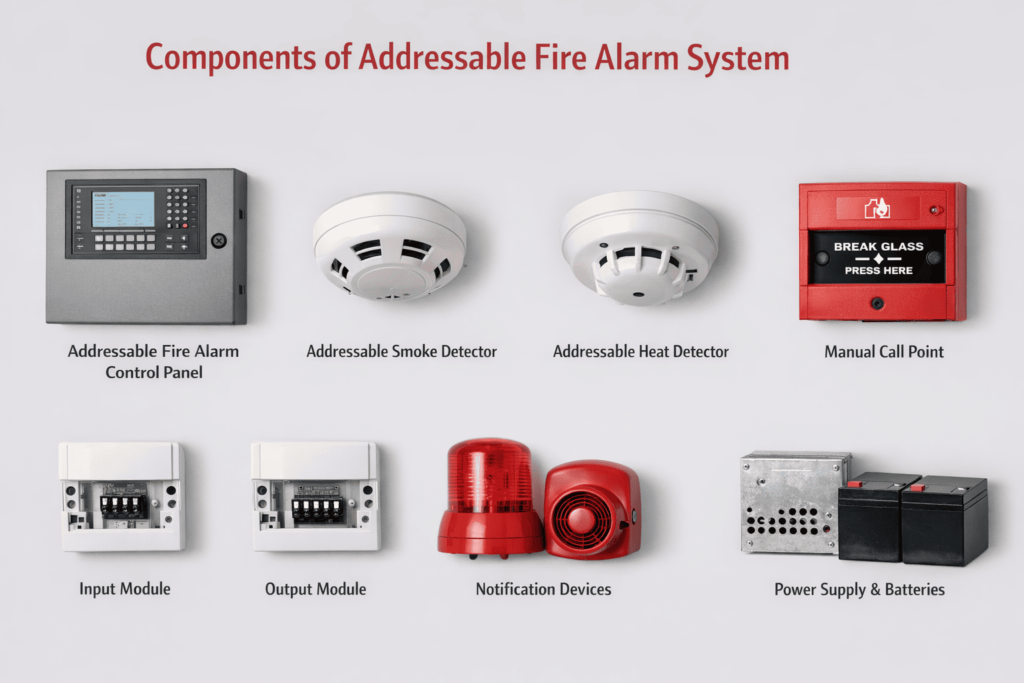
1) Addressable fire alarm control panel (FACP)
This is the main point where all the devices are controlled, the fire and the fault signals are processed, and the notification appliances are also activated.
2) Addressable smoke detector
These smoke detectors detect smoke and sends signals to the panel with precise address details and this allows fast and precise detection of fire.
3) Addressable heat detectors
Heat detectors are activated once the storage of specific temperatures has been reached and are commonly used in the kitchens, electrical rooms and in generator rooms.
4) Manual Call points (Break glass units)
Manual devices used to turn on the fire alarm in case of an emergency. Fire alarm systems that are programmed to QCDD standards must include them.
5) Addressable Input/output Modules
Modules which are indicative and control functions of external systems, fire sprinkler systems, fire pumps, HVAC shutdowns, and elevator recalls.
6) Strobe Lights and Fire Alarm Sounders
These are notification devices to inform occupants of the presence of fire using audible and visual assignment devices.
7) Power Supply and Backup Batteries
These will guarantee round-the-clock systems functioning, and back- up in event of power outages, as part of Qatar Civil Defence regulations.
Addressable Fire Alarm System Wiring Diagram
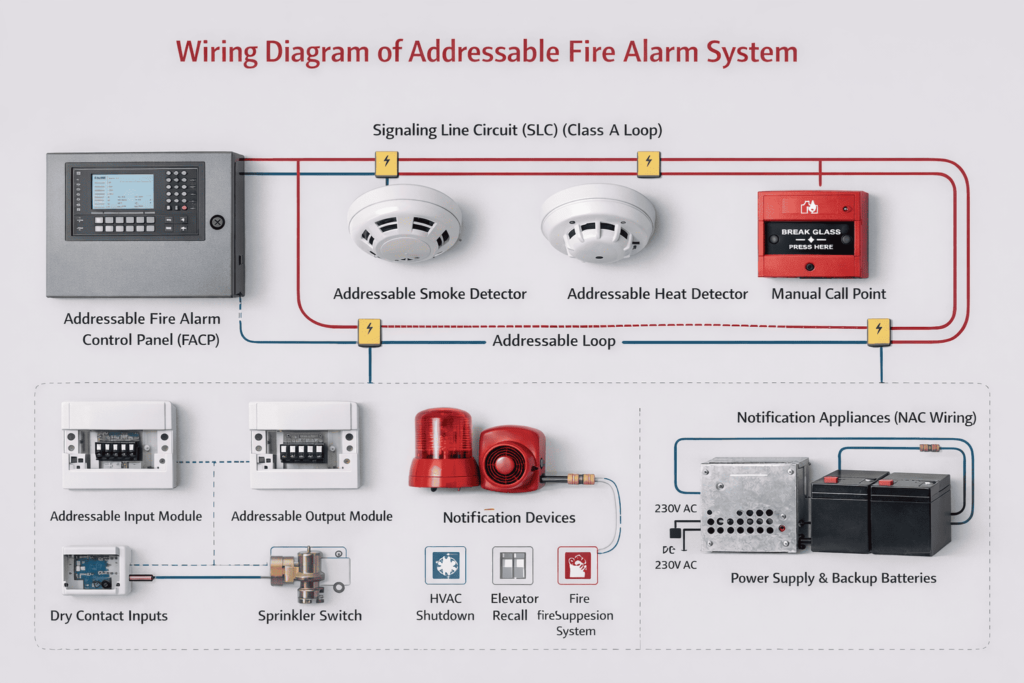
The addressable fire alarm system wiring diagram is centered on the Signaling Line Circuit (SLC), which is a supervised two-core fire-rated cable originating from the addressable fire alarm control panel, routed through all addressable field devices, and returned to the panel in a Class A loop configuration or terminated at the last device in a Class B configuration. The SLC provides both operating power and digital communication, with each smoke detector, heat detector, manual call point, and addressable module connected in parallel on the same loop using polarity-conscious terminals. Short circuit isolators are installed between device groups to maintain loop integrity during cable faults. Addressable output modules derive commands from the SLC and switch separate monitored circuits to control external systems, while monitor modules supervise dry contact inputs using End-of-Line (EOL) resistors for open and short circuit detection. Notification circuits, if not loop-powered, are wired separately from control modules or NAC terminals using supervised two-core cables with EOL resistors. The panel is supplied with dedicated 230V AC mains and standby batteries wired with correct polarity and protection.
Qatar Fire Alarm Standards and QCDD Compliance
All addressable fire alarm systems should receive QCDD approval and comply with quality standards in Qatar Construction Specifications (QCS 2014) and global NFPA guidelines. NFPA 72 is the National Fire Alarm and Signaling Code that is the primary standard implemented in designing the system, its installation, testing and maintenance.
Our Addressable Fire Alarm System Services in Qatar
We offer end-to-end QCDD approved addressable fire alarm system solutions all across Qatar that include:
- Supply and installation of addressable fire alarm systems.
- QCDD compliant design and approval support.
- Testing and commissioning
- Civil Defence Inspection Support
- Annual maintenance contract (AMC)
