
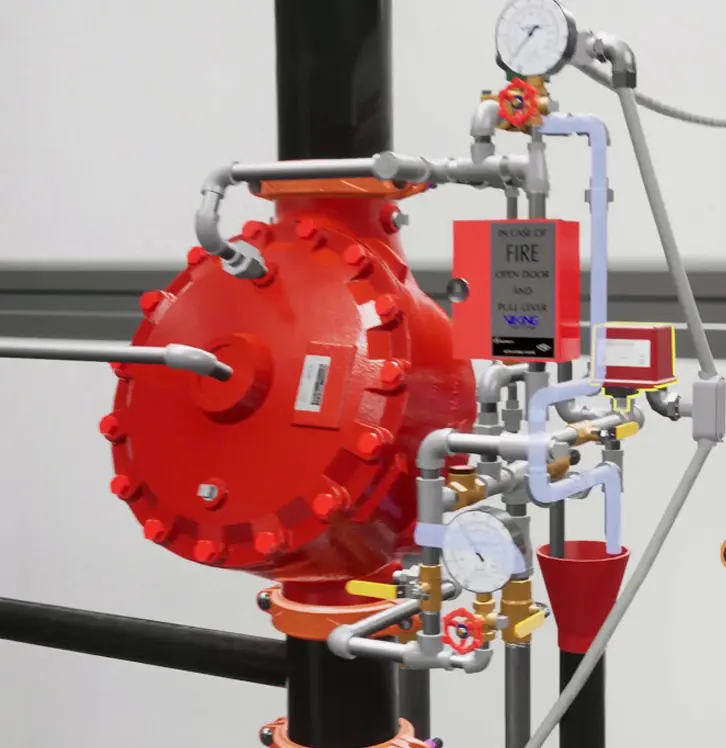
A deluge system is a water mist system using open spray heads attached to a piping system that is connected to a water supply through a valve that is opened by means of a detection system installed in the same area as the spray heads.
In extreme risk scenarios, fire can spread very quickly, and typical closed-head sprinkler systems can be inadequate. That is where deluge systems can give a ‘total flood’ solution with fire suppression through open nozzles across a wide area simultaneously.
Deluge systems are used in high hazard areas such as power plants, aircraft hangars, and chemical plants. They are very effective in hazardous areas because they release water or another fire suppressant to all the open sprinkler heads simultaneously.
What is a deluge system?
Deluge systems are dry-pipe fire suppression systems where all sprinkler heads are permanently open. Unlike traditional fire protection systems, the piping has no water and has no pressurized air. Water is retained by a proprietary deluge valve, and when a fire detection system (smoke, heat, or flame) activates, the valve opens, and water discharges through all the nozzles in that zone simultaneously.
What are the applications of Deluge System?
Deluge systems are required in environments where flash fires can occur.
- Aircraft Hangars: Protection against jet fuel fires.
- Chemical Processing Plants: Quick cooling of tanks that are volatile.
- Power Transformers: Protection against the fire of oil-filled pieces of equipment that can lead to total grid failure.
- Fuel Loading Racks: Fast suppression is critical here.
What is the difference between Deluge System and Pre-Action System?
Both systems operate with a deluge style valve, but the ceiling hardware is where the differences lie.
- Deluge Systems: Uses open nozzles. When the deluge valve is activated, water sprays everywhere.
- Pre-Action Systems: Uses closed heads with heat-sensitive bulbs. Even when the valve is opened, water only flows through heads at certain temperatures.
Main Components of a Deluge System
A deluge system is built on three combined sub-systems:
1. The Deluge Valve
Deluge system’s valve is a diaphragm type that is closed as long as water pressure is maintained in the priming chamber. When pressure is released via an actuator, the diaphragm opens, allowing water to flow into the system piping.
2. The Detection/Release System
Deluge valves do not self-activate. They need some extra trigger:
- Electric Release: Uses smoke or fire detectors, which are connected to a solenoid valve.
- Pneumatic/Hydraulic Release: Uses a pilot line of small-diameter piping, which has heat-sensitive heads that, when activated, drop the pressure holding the deluge valve closed.
3. Open Sprinkler Nozzles
These nozzles have no heat sensitive components, meaning there is no delay once water arrives at the nozzles. NFPA 13 standard controls the spacing of the nozzles to ensure “density” (gallons per minute per square foot) complies with the hazard class.
Installation and NFPA Compliance
Deluge systems need to be built according to NFPA standards, installed according to NFPA 13 standards and maintained by NFPA 25 standards.
Maintenance Requirements
Weekly/Monthly: Check for corroded pipe and make sure the manual trip is within reach.
Yearly: A “full trip test” has to be conducted on yearly basis. This means it needs to be tripped to show that the valve opens, and within the required 40 seconds, water is to the farthest nozzle.
5 Years: Inspect the internal clapper and rubber gasket of the valve.
Advantages and Disadvantages
Advantages
Fast Activation: This is the best fire protection system for “fast combustion” type fires.
Comprehensive Coverage: Protects against fire spread for non-ignited ignition sources by cooling the equipment to reduce thermal radiation.
Disadvanatges
Water Destruction: To fully activate may ruin a lot of equipment that is not burning.
Recovery: A lot of recovery and cleanup will need to happen after it is activated.
There needs to be a detailed hazard analysis done when selecting a deluge sprinkler system. It is the gold standard for protecting lives and assets when dealing with flammable liquids and when space permits, and with valuable machinery, it is ideal for protecting assets.
Expert Deluge System Installation in Qatar
When protecting high-value assets like aircraft hangars, chemical plants, or power transformers in Qatar, the quality of installation is just as critical as the system design. Total Fire Protection (TFP) is a leading fire protection company in Doha, specialized in the engineering, supply, and maintenance of advanced deluge water spray systems.
