

A fire hydrant is an important part of the fire protection system of a building. Fire hydrants are intended to enable access to water supply immediately in case of an emergency that might cause disasters but the firefighters and trained personnel can contain and deal with fires in a prompt and efficient manner. Be it commercial buildings, an industrial premise, residential complex, warehouse or even a shopping mall, an adequate and designed fire hydrant system provides maximum security as well as adherence to fire safety rules.
What is a Fire Hydrant?
A fire hydrant is an above the ground or under the ground water outlet which is incorporated in a highly pressurized water supply system. It enables firefighters to run hoses and take high-pressure water in case of a fire.
A larger fire fighting system that contains fire hydrants may include:
- Fire pump (diesel fire pump, electric fire pump, jockey pump)
- Deep and surface water reservoirs.
- Fire hydrant valves
- Landing valves
- Hose reels
- Fire brigade inlet inlets.
- Fittings and fire hydrant pipes.
Types of Fire Hydrants
On the basis of climate conditions, mainly two types of fire hydrants are used.
Wet Barrel Fire Hydrant
A wet barrel fire hydrant is a type of hydrant in which the barrel remains permanently filled with pressurized water from the supply main. Unlike dry barrel hydrants, there is no main valve located below ground level. Instead, each outlet nozzle is individually controlled by its own valve mechanism. This means water is present throughout the hydrant body at all times, allowing immediate discharge once a nozzle valve is opened.
Structurally, a wet barrel hydrant consists of an above-ground cylindrical barrel connected directly to the underground water main. It typically includes two 2½-inch hose outlets and one larger 4-inch or 4½-inch pumper connection. Each outlet has a separate stem-operated valve housed within the bonnet assembly. Because the hydrant is constantly charged with water, no internal drain mechanism is required. The inlet connection is generally flanged or mechanically joined to the fire service main, and an external isolation valve on the pipeline is necessary for maintenance purposes.
Operationally, the hydrant remains under static system pressure at all times. When a firefighter opens a specific outlet, only that valve activates, allowing controlled water discharge through that nozzle without affecting the other outlets. Multiple nozzles can be operated simultaneously. The absence of a single main valve reduces mechanical complexity and allows faster activation compared to dry barrel designs.
Wet barrel hydrants are specifically designed for non-freezing climates where ambient temperatures do not fall below 0°C. Because water remains inside the barrel continuously, freezing conditions could cause structural damage or rupture. For this reason, wet barrel hydrants are widely used in warm and tropical regions, including the Middle East and coastal environments, as well as in municipal and private fire protection systems in similar climates.
Dry Barrel Fire Hydrant
A dry barrel fire hydrant is a frost-protected hydrant design in which the barrel remains empty of water under normal conditions. Water is retained below ground level by a single main valve located at the base of the hydrant, beneath the frost line. This configuration prevents freezing in cold climates while maintaining readiness for firefighting operations.
The hydrant consists of an above-ground barrel, a bonnet assembly with operating nut, outlet nozzles, a long operating stem, and a base-mounted main valve. The operating stem runs from the top operating nut down to the main valve seat. When the hydrant is closed, the main valve isolates the pressurized water main, keeping the barrel dry. Upon opening the hydrant, rotation of the operating nut lifts the main valve, allowing water to flow upward into the barrel and out through the nozzles. When closed, an automatic drain mechanism opens to discharge residual water from the barrel into the surrounding soil, preventing freezing.
Dry barrel hydrants typically include two 2½-inch hose nozzles and one 4-inch or 4½-inch pumper connection. Unlike wet barrel hydrants, the outlets do not have independent valves; water supply to all nozzles is controlled by the single base valve. Outlet caps protect threads and prevent debris ingress. The inlet is connected to the underground fire service main via a flanged or mechanical joint connection, and an external isolation valve is usually installed on the branch line for maintenance.
Components of a Fire Hydrant System
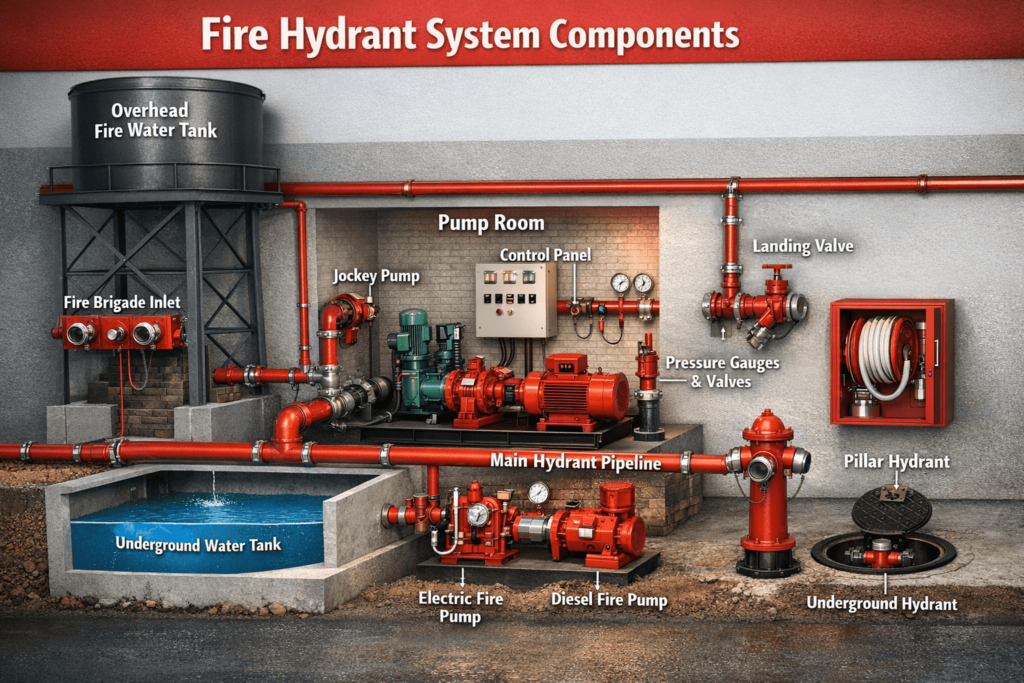
A full fire hydrant system consists of:
- Hydrant pump room
- Fire hydrant pump set
- Landing valves and hydrant valves
- Fire hose cabinet
- Fire hose reel drum
- MS/GI pipeline network
- Pressure gauges
- Control panels
All the components should be in line with NFPA standards and local fire department requirements as well as building safety standards.
Installation of Fire hydrants
Installation of of hydrants generally involves:
- Risk assessment and site inspection.
- Hydraulic computation and system design.
- Pipeline layout planning
- Installation and selection of fire pumps.
- Hydrant valve placement
- Load testing and commissioning.
- QCDD certification
A proper system design will have sufficient water pressure, flow rate, and coverage.
Maintenance and Inspection
The maintenance of fire hydrants should always be done to maintain the reliability of the given system. Failure to check this may result in the loss of pressure, or leakage; or even failure of the system when needed.
The maintenance activities are:
- Monthly visual inspection
- Pressure testing
- Valve lubrication
- Hose condition check
- Pump performance testing
- Flow test and flushing
Fire hydrant systems Annual Maintenance Contracts (AMC) assist businesses to keep at level with compliance and penalties.
Commercial and Industrial Building Fire Hydrant System
In the cases of commercial buildings, factories, warehouses, hospitals and high-rise towers a fire hydrant system is usually compulsory. Massive plants need high pressure fire hydrant system combined with:
- Fire sprinkler systems
- Fire detection and alarm systems
- Fire suppression systems
- Fire water storage tanks
Fire hydrant systems used in industries are developed depending on the designation of hazards and the type of occupancy in the building that ensures full protection against the fire.
Cost Factors of Fire Hydrant System
The price of a fire hydrant system will be determined by:
- Building size and layout
- Number of hydrant points
- Pipe network length
- Pump capacity
- Hydrant type (wet/dry/underground)
- Regulatory requirements
Tailor designed system would provide a cost effective, but complete compliant fire protection.
Need fire hydrants installation and service?
Total Fire Protection is a Grade A certified fire protection company in case you require installation of fire hydrants, testing drive or commissioning, or AMC services. An adequate and well-nursed fire hydrant network can spell the difference amidst the trivial loss and the gigantic loss. Invest in a straightforward yet effective fire fighting system that incorporates fire hydrants to ensure the future of lives, property and business. Contact us for quote today!
